Why Every Fantasy Football League Needs a Last-Place Punishment
For many—perhaps most—the draft is the most enjoyable part of the fantasy football year. Only one team gets to enjoy the very end: the team holding the trophy. But everyone has fun at the beginning.
That’s when every team is the Dallas Cowboys: Hopes are high. Smack talk is unchallengeable. Everyone’s draft was brilliant. And, of course, the Super Bowl is a sure thing… then the season begins.
As the weeks progress, hopes begin to fade. The smack talk dies because it can no longer be backed up. Winning the league becomes next year’s white whale.
And that’s when some owners become disinterested and bitter.
They stop picking up free agents. They stop setting competitive lineups. They start Christian McCaffrey—who’ll be on IR by Week 11 —or try to trade Bijan Robinson to their wife for AJ Barner and a night out with the guys.
But what if you could ensure that every team fights tooth and nail until the final game of its season while also giving all but one of your owners something to look forward to at the end of the year?
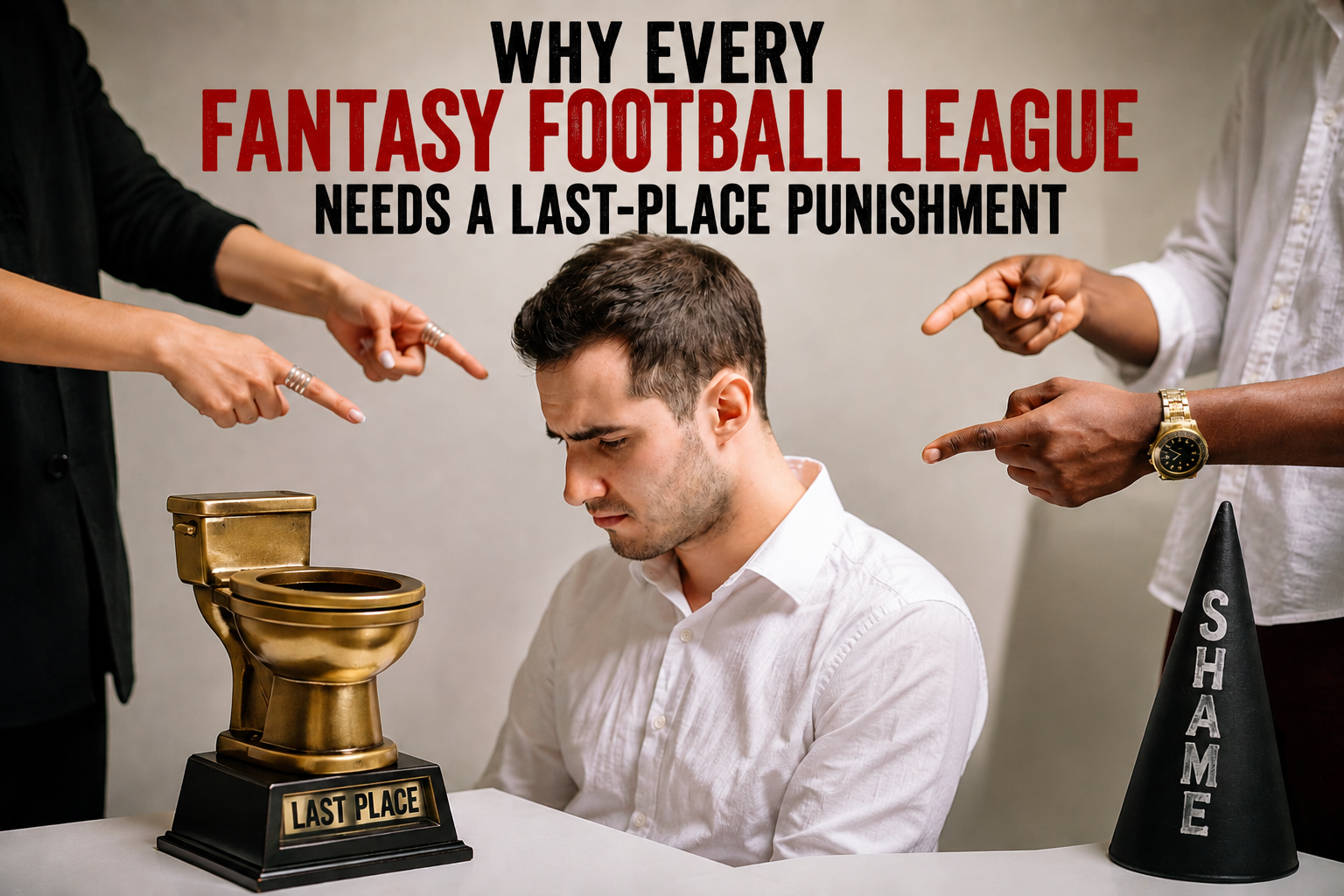
You can. Set up a league punishment for the worst team in the league.
A good punishment can keep eliminated teams engaged because nobody wants to be the guy who finishes last. It gives your league something to talk about throughout the season and, if done correctly, can create a tradition that lasts for years.
But before you start designing the humiliation, there are some things your league needs to figure out.
Set the Punishment Before the Draft
Before the season starts—preferably before the draft—decide on a list of potential punishments for the worst team in the league. Some suggestions are included at the end of this article.
Be as detailed as possible about the requirements of each punishment and send the list to everyone in the league before the draft. This gives everyone an opportunity to understand exactly what they’re agreeing to. Then, on draft night, decide as a league which of those punishment you want to inflict.
Do not wait until someone has already lost to decide what his punishment will be.
If you have some weak owners in your league who are already complaining about the concept, tell them not to lose. Or, if you’d prefer, create a “menu” of punishments from which the loser can choose. They can pick the punishment they hate the least, but they are still required to complete at least one. The important thing is that everyone knows the rules before the season begins.
Define the Loser
The league needs to come to an agreement on what constitutes the “league loser.” Is it:
- The team with the worst record?
- If two teams tie, what is the tiebreaker?
- The team with the fewest total points?
- Do postseason points count?
- The loser of the consolation bracket?
- The team with the fewest drafted players remaining on its roster?
- The team that bitched the most during the year?
Whatever method you choose, define it before the season begins. There should be no debate at the end of the year about who has to pay.
Who Pays for It?
Some punishments are free. Others cost money. If the punishment you’ve selected has a cost, determine beforehand who is responsible. Does the league pay for it as a group? Does the loser pay? Is there a spending limit? Are reasonable expenses reimbursed?
If the punishment involves a restaurant, travel, tickets, professional photography or anything else that costs money, establish the rules before anyone knows who will be paying. The last thing you want is for the loser to discover that the punishment everyone agreed to costs $1,500.
Close the Loopholes
Fantasy football owners are very good at finding loopholes. Don’t leave any. Make sure a minimum duration is defined. Explicitly state whether the loser can modify or alter anything. Specifically state where the punishment will occur. Clearly lay out all the required elements.
You don’t want someone who is required to wear a tutu to Opening Day to wear a trench coat over it or show up at 3:00 in the morning for an hour.
If the punishment is supposed to be embarrassing, make sure it is actually embarrassing. At the same time, don’t make the rules so complicated that completing the punishment becomes impossible.
The Enforcer
Someone needs to make sure the punishment is adequately completed. It would seem only fair to give that year’s champion the honor.
The commissioner would also be a solid choice. Whoever is chosen should have the final say on whether the punishment was successfully completed or whether the loser failed to complete some part of it. This person should also have the authority to resolve disputes about ambiguous situations. And, ideally, everyone should agree to that authority before the season begins.
How Do You Prove It?
Ideally, the punishment will take place sometime after your Super Bowl, at a location and time where everyone in the league can show up and participate in the joy of watching the punishment go down.
Unfortunately, that’s not always possible. If your league is spread across the country—or even across different continents—decide beforehand how proof of completion will be established. Will the punishment be livestreamed? Will it be recorded? Will simple photographs work? Will there need to be live witnesses? Does the loser have to post the evidence to social media?
Decide before the season. And remember: documentation makes the punishment better. Pictures and videos become part of your league’s history and give everyone something to laugh about at future drafts.
Consequences for Refusal
At some point, it is probable that an owner will refuse to complete their punishment. Therefore, you will need a punishment for refusing to accept the punishment. Some options include:
- Additional league dues
- Loss of draft picks the following year
- A fantasy penalty to begin the following season
- Two additional punishments from the original list
- Removal from the league
A fantasy penalty could mean starting the season with a negative point total in a total-points league or being prohibited from starting a particular position for the first couple of weeks. Whatever consequence you choose, establish it before the season. And if it’s an owner you don’t particularly like? Well, maybe it’s time to find someone who knows how to follow the rules.
Allow for Exceptions
The punishment will most likely take place a good four months after the draft. A lot can happen in four months. If a legitimate reason arises that prevents the loser from performing the punishment—a medical issue, work obligation, birth of a child or some other unavoidable circumstance—work around it. But don’t eliminate it.
Reschedule the punishment. Don’t cancel it. The goal is to make the punishment fun for the league, not to create a situation where someone has to choose between fantasy football and a legitimate life obligation.
Consider Your Audience
People play fantasy football with a lot of different people from a lot of different places. When designing punishments, keep in mind who you’re playing with. Punishments for a fraternity league that has been together for 25 years should probably look very different from punishments for a first-year work league. Know your audience.
A punishment that will have twelve lifelong friends crying with laughter might get someone fired in a workplace league. Keep the punishment embarrassing, funny and memorable—but establish boundaries that everyone can live with.
Put It in Writing
If you’re going to make a punishment part of your league, make it part of your rules.
All legitimate leagues have a set of bylaws. They tell you whether the league is PPR or standard. They tell you how many players are in your starting lineup. They tell you how waivers work, how trades are handled and how the playoffs are structured.
They should also tell you whether you’re going to be punished at the end of the year, how the punishment works and what happens if you refuse. If it’s not a rule, it’s not enforceable. Put it in writing. Have everyone agree to it. Then draft.
Fantasy Football Punishment Suggestions
Now for the fun part. The best punishment isn’t necessarily the most extreme. It’s the one that is funny, memorable and just uncomfortable enough that nobody wants to finish last. Here are some ideas to get your league started.
The Public Busker
The loser has to go to a crowded public place—outside a sporting event, at a train station or another appropriate location—with an instrument chosen by the league. They must busk for cash while holding a sign that reads: “I Suck at Fantasy Football and Need Lessons. Any Amount Will Help.” They can’t leave until they’ve raised a predetermined amount of money.
Karaoke Night
The loser has to go to karaoke night and sing three songs chosen by the league. And there’s one important rule: They have to sing seriously. No goofing around. No laughing. No intentionally terrible performance. They have to sing with intensity and passion. If they crack up or deliberately sabotage the performance, they have to sing the song again.
The Loser Date
The loser has to dress in a tuxedo—or formal attire—and have a one-hour dinner at a fancy restaurant with a blow up doll (or other ridiculous “date,” such as a teddy bear or another predetermined prop). They have to order their date dinner and interact with it as though it were a real date. This is the sort of punishment that works particularly well when the league can be seated nearby to observe.
The Dating Profile
The league takes control of the loser’s dating profile for a predetermined period. They can change the profile, swipe left or right at will and even respond to messages. This punishment needs to be handled carefully. The goal is embarrassment—not actual damage to someone’s personal life.
Open Mic Night
The loser has to attend an open mic night and perform a comedy routine written entirely by his league mates. The loser gets the stage. The league gets the laughs. And the loser gets to discover exactly how funny his friends think he is.
The Loser T-Shirt
The league designs a custom T-shirt for the loser. The shirt can prominently advertise his fantasy-football failure or something else entirely. Then the league chooses an appropriate event where the loser has to wear it. The more creative the shirt, the better.
Take the SAT/ACT
The loser has to register for the SAT or ACT and take the test. Then they have to post their score for the league to see.
The League Waiter
The loser has to act as the waiter or maid for a league dinner, draft or party. They have to wear the outfit, serve everyone and clean up when the meal is over. The league should establish reasonable boundaries beforehand, but the basic premise is simple: The loser serves the winners.
The Loser Calendar
The league chooses 12 ridiculous outfits or scenarios. The loser has to take one picture in each. Then create a calendar using those photos. Every member of the league gets a copy. The loser has to hang one at work for the year. This one has an added advantage: It can become a permanent artifact of league history.
Sing the National Anthem
The loser has to arrange to sing the national anthem before a local youth sporting event. This one requires cooperation from the event organizers, so the league should arrange it in advance.
The Haircut
The loser has to shave an eyebrow, dye their hair or get a haircut chosen by the league. Unless agreed upon, make sure the alteration is not permanent. The point is to make the loser look ridiculous for a while—not create a permanent consequence for losing a fantasy football league.
Make Last Place Matter
The beauty of a good fantasy football punishment is that it changes the way people play. A team that is eliminated from championship contention still has something to fight for.
The owner sitting in 10th place in Week 12 might not be able to win the league—but he can still avoid finishing last. That owner might make the waiver claim. He might set his lineup. He might refuse to trade away his best players for nothing. He might actually pay attention.
And suddenly, the entire league has something to play for. That’s what makes a good last-place punishment more than just a way to embarrass somebody. It keeps the league competitive. It keeps people engaged. It creates rivalries. And, most importantly, it creates stories.
Because ten years from now, nobody is going to remember who finished seventh in your fantasy league in 2026. But they might remember the guy who had to sing karaoke in a tutu because he drafted a quarterback in the first round and finished dead last.
Don’t just crown a champion. Give everyone a reason to avoid being the loser.