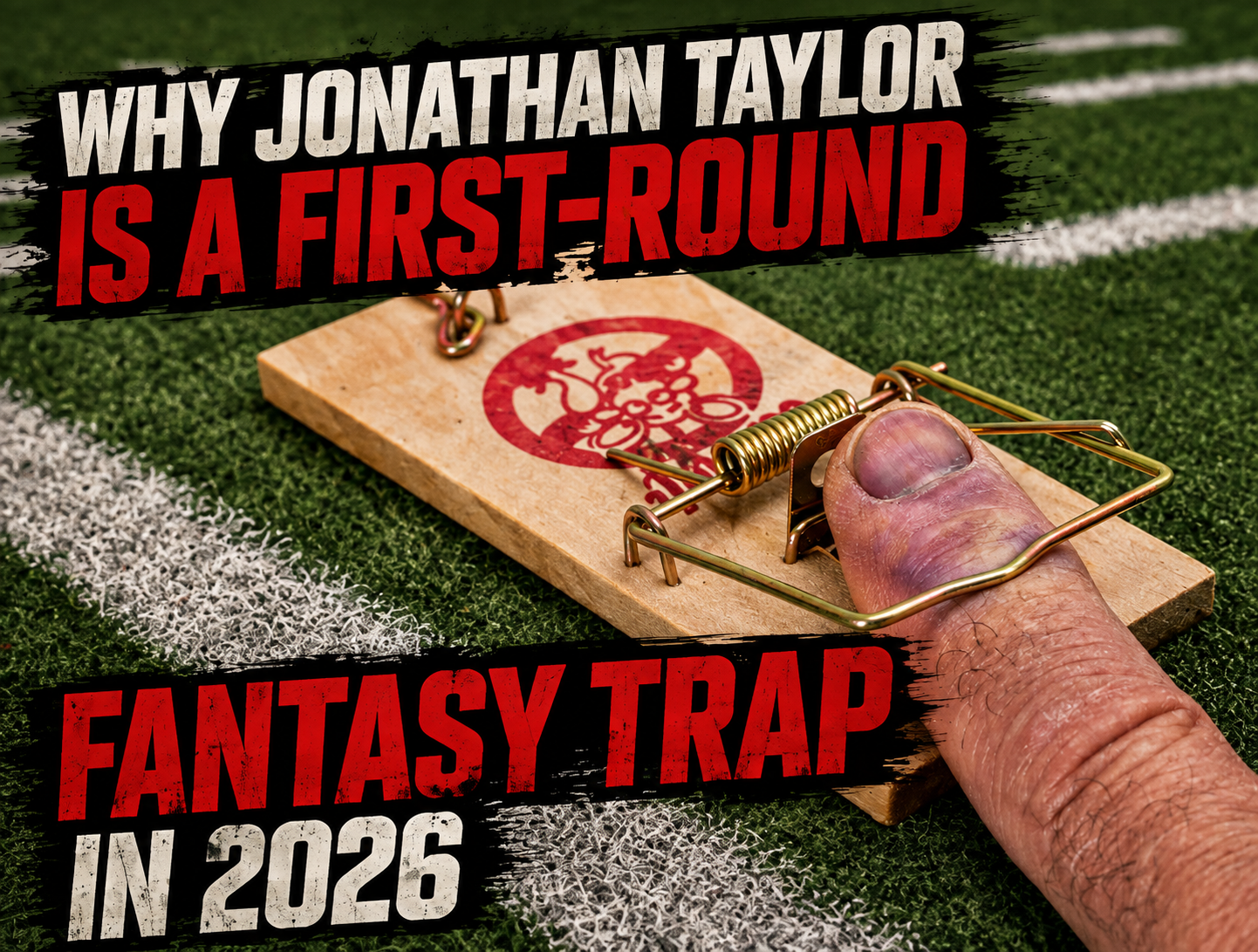
Pig in a Poke: Why Jonathan Taylor Is a First-Round Fantasy Trap in 2026
Here at PigSkinFantasy, we’ve built a website designed to help you become a better fantasy football player. Our goal is to provide insights you may not have considered, make you laugh once in a while, and occasionally leave you with a little piece of knowledge you can use outside of fantasy football.
Today’s knowledge nugget: “Pig in a poke.”
A “Pig in a Poke” is a bust, in layman terms.
If you’d like a knowledge boost outside of fantasy football, check out the end of this article.
If you just want fantasy football insight, keep reading…
Our first potential bust (Pig in a Poke) is Jonathan Taylor.
Jonathan Taylor: A Risky First-Round Investment
Jonathan Taylor led the NFL with 323 rushing attempts and 18 rushing touchdowns last season while also setting a career high with 46 receptions. He posted the highest-scoring fantasy performance of the season in Week 10 against Atlanta and finished as the overall RB2, trailing only Christian McCaffrey.
If this were 2025, Taylor would be an easy choice as the second running back off the board.
But this is 2026—and several red flags deserve your attention.
Red Flag #1: Touchdown Regression Is Coming
Taylor scored 18 rushing touchdowns on 323 carries, finding the end zone on 5.7% of his rushing attempts.
League average touchdown rates for starting running backs typically hover around 3%.
Unless Taylor suddenly becomes an outlier for a second consecutive season, that scoring efficiency is almost certain to regress. Assuming he receives a similar workload, statistical regression alone would project him much closer to 9 rushing touchdowns than another 18-score campaign.
Touchdowns are notoriously volatile from year to year, and fantasy managers often overpay for last season’s production.
Red Flag #2: His Second Half Was Concerning
Taylor dominated fantasy football through the first 10 weeks of the season, leading all running backs in fantasy points per game.
From Weeks 11-17, however, he fell all the way to RB22.
Some managers point to Daniel Jones’ injury, but Taylor’s decline actually began before Jones went down.
During that stretch:
- Yards per carry dropped from 6.0 to 3.3
- Yards per game fell from 114 to 64
- Overall efficiency cratered
Jones is expected back by Week 1, but quarterbacks returning from Achilles injuries historically experience noticeable declines in performance. If Jones isn’t the same player—or loses some of his mobility—defenses will have fewer reasons to respect Indianapolis’ passing game and can devote additional resources to stopping Taylor.
Red Flag #3: The Curse of 370 Touches
One of fantasy football’s most well-known historical trends is what many refer to as the 370-Touch Curse.
Approximately 85% of running backs who record more than 370 touches in one season experience an average decline of roughly 40% in production the following year, while more than two-thirds miss at least four games.
Over the past two decades, only two players have exceeded 370 touches and improved the following season:
- Clinton Portis (2007-08)
- Ray Rice (2010-11)
Taylor finished last season with 369 touches—essentially sitting on the doorstep of that threshold.
Even more concerning, we’ve already seen this story before.
After totaling more than 370 touches in 2021, Taylor followed it up by:
- Missing six games
- Seeing his yards per carry fall from 5.4 to 4.4
- Watching his touchdowns plummet from 20 to 4
He entered that season as the consensus RB1 and ultimately finished as RB33.
History isn’t guaranteed to repeat itself—but it certainly rhymes.
Red Flag #4: The 2,000-Touch Cliff
Perhaps the biggest warning sign isn’t last season.
It’s Taylor’s entire football career.
Jonathan Taylor currently has 1,738 NFL touches, meaning he’ll almost certainly surpass the 2,000-touch cliff during the 2026 season.
Historically, that’s the point where many elite running backs begin experiencing sharp declines in efficiency and durability.
But Taylor’s workload doesn’t begin in the NFL.
During just three seasons at Wisconsin, he accumulated an astonishing 968 collegiate touches. He averaged more touches, per season, than any player in NCAA history. Most NFL-caliber running backs enter the league with roughly 400-600 college touches.
Taylor nearly doubled that.
When his NFL and college workloads are combined, Jonathan Taylor has handled 2,706 career touches.
No matter how you view workload analytics, that’s an enormous amount of mileage.
Final Verdict
Jonathan Taylor has been one of the NFL’s premier running backs, and there’s no denying his talent.
But fantasy football isn’t about paying for what a player has done—it’s about projecting what he’s likely to do next.
Taylor enters 2026 carrying several significant warning signs:
- Significant touchdown regression appears likely.
- His second-half efficiency dropped dramatically.
- He’s coming off an enormous 369-touch workload.
- He’s approaching the NFL’s 2,000-touch cliff while already carrying nearly 1,000 additional college touches.
- Indianapolis’ passing game could struggle with Daniel Jones returning from a major Achilles injury.
When you’re investing a first-round pick—currently around ADP RB4 and No. 8 overall—you want as few question marks as possible.
Jonathan Taylor has too many.
Pig in a Poke Explained
Like the merchants of the 1500s, fantasy managers who buy into a player without fully inspecting what they’re purchasing may discover they’ve drafted a pig in a poke.
Unless you’ve got a little gray in your beard, you’ve probably never heard the phrase.
Dating back to the 1500s, a pig in a poke referred to buying something without inspecting it first. Merchants sold pigs tied inside bags—called pokes—but dishonest sellers would sometimes substitute a cheaper animal, like a cat, leaving buyers disappointed and lighter in the purse.
The lesson? Never buy something sight unseen.
That same principle applies to fantasy football.
It’s generally accepted that you won’t win your league in the first few rounds of your draft—but you can absolutely lose it. Missing on an early-round cornerstone puts you behind the eight ball before Week 1 even kicks off.
With that in mind, we examined the top 36 players by current ADP and looked for warning signs that fantasy managers may be missing.