
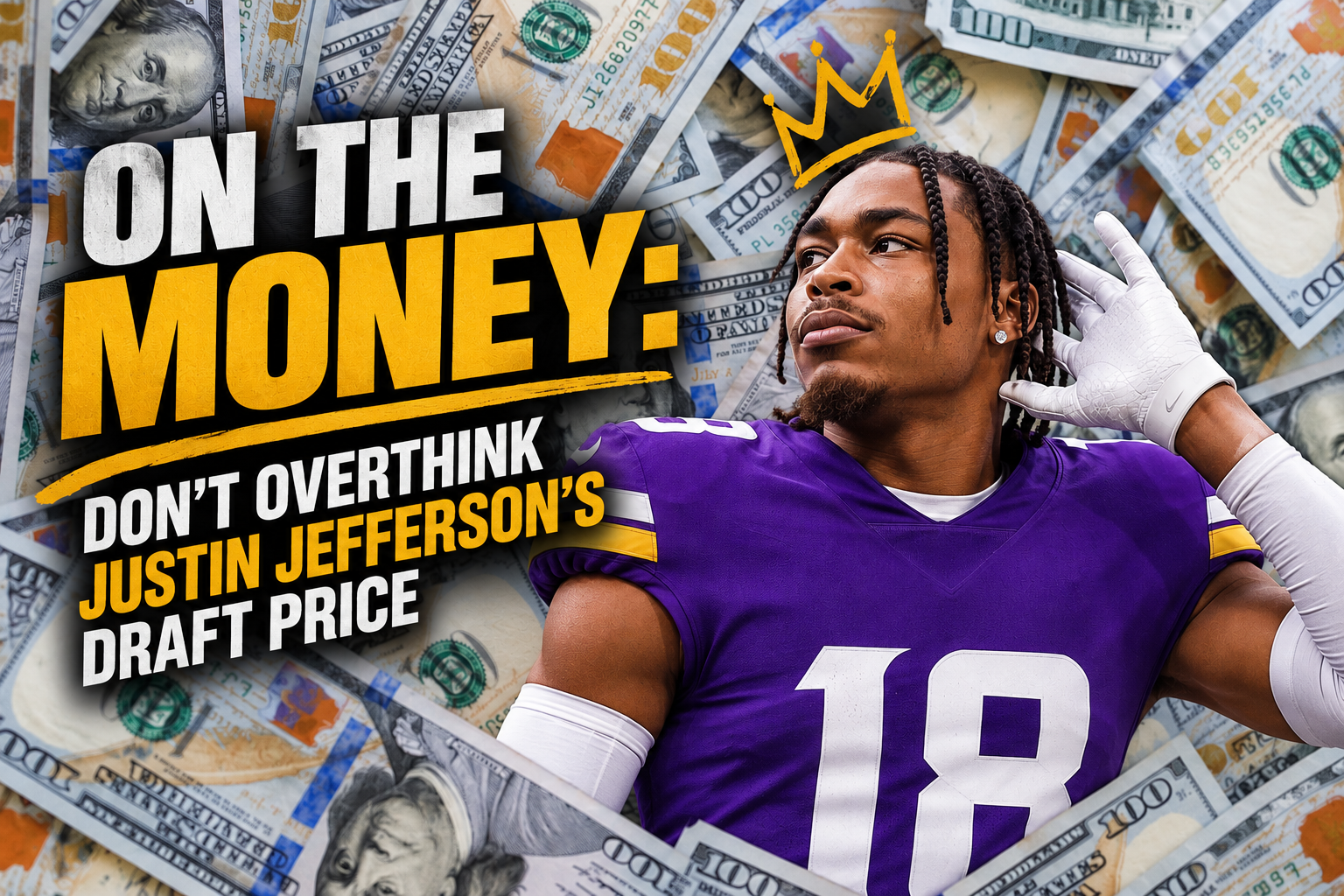
On the Money: Don’t Overthink Justin Jefferson’s Draft Price
Fantasy football analysis has become pretty good at telling you who is being overdrafted. We love finding the guy going in Round 2 who should be going in Round 4. We love identifying the player whose ADP is being inflated by last year’s stats, a flashy name or three highlight-reel games. And, of course, we love telling you which pigs are wandering toward the wrong trough. But every once in a while, the fantasy football market gets something exactly right.
Justin Jefferson is one of those times.
Jefferson is currently being drafted around the 11th or 12th pick overall in PPR leagues. That’s roughly where FantasyPros’ expert consensus has him as well. And you know what?
That feels about right. Not a bargain. Not a reach. Not a player you need to talk yourself into.
Welcome to On the Money.
A Three-Month Climb
Jefferson’s ADP hasn’t been sitting still this offseason. Coming out of last season, there was plenty of skepticism. That’s understandable. Jefferson’s 2025 numbers weren’t simply below his career standards. They were way below them.
He finished with just 68 receptions for 1,048 yards and two touchdowns. Two touchdowns. For Justin Jefferson. Fantasy managers saw those numbers and started asking questions.
Has the quarterback situation finally caught up with him?
Is the Minnesota offense going to limit his ceiling?
Are we still looking at the same Jefferson who routinely went in the top five?
And, perhaps most importantly: How much are we willing to pay for the rebound?
The market spent much of the offseason figuring that out.
As the summer progressed, Jefferson climbed back toward the front of the first round. By June and July, FantasyPros was already discussing him as a legitimate option around the 1.10 range.
Today, he’s settled in around 1.11/1.12. That climb tells us something. Fantasy managers aren’t ignoring what happened last year. They’re simply starting to believe that last year was the exception rather than the new normal.
And that’s the right conclusion.
Don’t Let Two Touchdowns Fool You
Let’s get one thing straight. Justin Jefferson didn’t suddenly forget how to play wide receiver. His 2025 season was a product of an offense that simply wasn’t very good. The quarterback play was inconsistent. The passing game struggled. The Vikings didn’t generate the kind of passing volume we’ve come to expect from an elite fantasy environment.
And yet Jefferson still commanded 141 targets. That number matters, because targets are opportunities. And Jefferson continued to get them. The problem wasn’t that Minnesota stopped looking for him. The problem was what happened after the ball left the quarterback’s hand.
His catch rate fell to 59.6%, and his yards per target dropped considerably from his career norms. That’s a pretty important distinction. If Jefferson had suddenly become an afterthought in the offense, we’d have a much bigger problem.
He didn’t. The targets were still there. The efficiency wasn’t. And that’s a much easier problem to fix.
The Kyler Murray Factor
Now comes the fun part. Kyler Murray. Whether you love Murray, hate Murray or simply have no idea what to make of him anymore, there’s one thing we know:
He can throw the football.
And Jefferson doesn’t need Murray to become the second coming of Peyton Manning. He doesn’t need Minnesota to throw the ball 700 times. He doesn’t even need everything to go perfectly. He just needs the Vikings’ passing offense to become functional again.
That’s not exactly an outrageous projection.
Minnesota ranked near the bottom of the league in passing production last season, and the Vikings’ passing touchdowns were particularly disappointing. Jefferson still saw 141 targets in that environment. Imagine what happens if the quarterback play improves and Minnesota’s passing game starts functioning like an NFL offense instead of a weekly science experiment.
Suddenly, we’re talking about a receiver who can push toward 90–100 receptions, 1,300+ yards and significantly more touchdowns. And if that happens? You’re looking at a legitimate top-five fantasy receiver.
Here’s the Catch
There is a reason we’re not telling you to draft Jefferson at No. 4. There are still questions.
Kyler Murray is not a guarantee.
Jordan Addison isn’t going anywhere.
T.J. Hockenson is another legitimate receiving weapon.
And the Vikings aren’t suddenly guaranteed to become the league’s highest-volume passing offense.
That’s the other side of the Jefferson equation. The upside is enormous. But the risk isn’t imaginary. And that’s why the current ADP makes so much sense.
If Jefferson were being drafted fourth overall, we’d call that too expensive. If he were falling into the middle of the second round, we’d start calling him a value. Instead, he’s sitting right in the middle of those two extremes. Pick 11 or 12. That’s the sweet spot.
Remember What This Pig Has Done
Sometimes fantasy managers have a bad habit of treating one disappointing season like it erases everything that came before it. Don’t do that with Jefferson. This is a player who began his career with six straight 1,000-yard seasons. A player who has averaged roughly 92.5 receiving yards per game for his career. A player who has already demonstrated that he can carry a fantasy roster. And he’s only 27. We’re not betting on some washed-up veteran rediscovering his youth. We’re betting on an elite receiver having a better season than he had last year.
That’s a pretty easy pig to bet on.
The Ceiling Is Better Than His ADP
Here’s what makes Jefferson particularly interesting at his current price. You don’t need him to return to his absolute peak to make this pick work. At No. 11 or No. 12, you aren’t asking Jefferson to be the No. 1 player in fantasy football.n You’re asking him to be a first-round fantasy asset. That’s a much easier assignment.
If he finishes WR8, you’re probably perfectly happy. If he finishes WR5, you got exactly what you paid for. And if the quarterback upgrade works, the offense improves and Jefferson’s touchdown luck swings back toward normal? He can finish considerably higher than that.
That’s the upside. You’re paying a first-round price for a player with a realistic top-five ceiling. But you’re not paying the top-five price.n That’s what makes this different from an overdrafted player.
This Is What “On the Money” Means
There’s nothing particularly sexy about saying: “Draft Justin Jefferson at his ADP.” We understand that. Fantasy analysts are supposed to find the hidden gems. The guys nobody else sees coming.
But that’s not what On the Money is about. We’re looking for players where the fantasy market has done the math pretty well.
Jefferson’s current price accounts for:
- The disappointing 2025 season
- The quarterback uncertainty
- The competition for targets
- The possibility that Minnesota’s offense remains inconsistent
But it also accounts for:
- His elite talent
- His enormous target share
- His career production
- His age
- The possibility of a quarterback upgrade
- And the very real chance that 2025 was simply a down year
That’s a pretty reasonable equation.
The PigskinFantasy Verdict
Justin Jefferson isn’t a sleeper. Don’t expect to draft him at pick 35 and then pat yourself on the back for discovering something everyone else missed. He’s not a player we’re warning you away from, either. There’s too much talent and too much upside to be scared away by one bad statistical season.
Instead, we’re going to do something considerably less exciting: We’re going to agree with the market.
At approximately 1.11/1.12, Justin Jefferson is being drafted exactly where he should be. You’re paying a premium for an elite receiver. You’re getting a discount for the risk. And you’re buying a player with a very legitimate path back to the top of the fantasy wide receiver rankings. That’s not a steal. That’s not a reach.
That’s a pig at the right trough.